
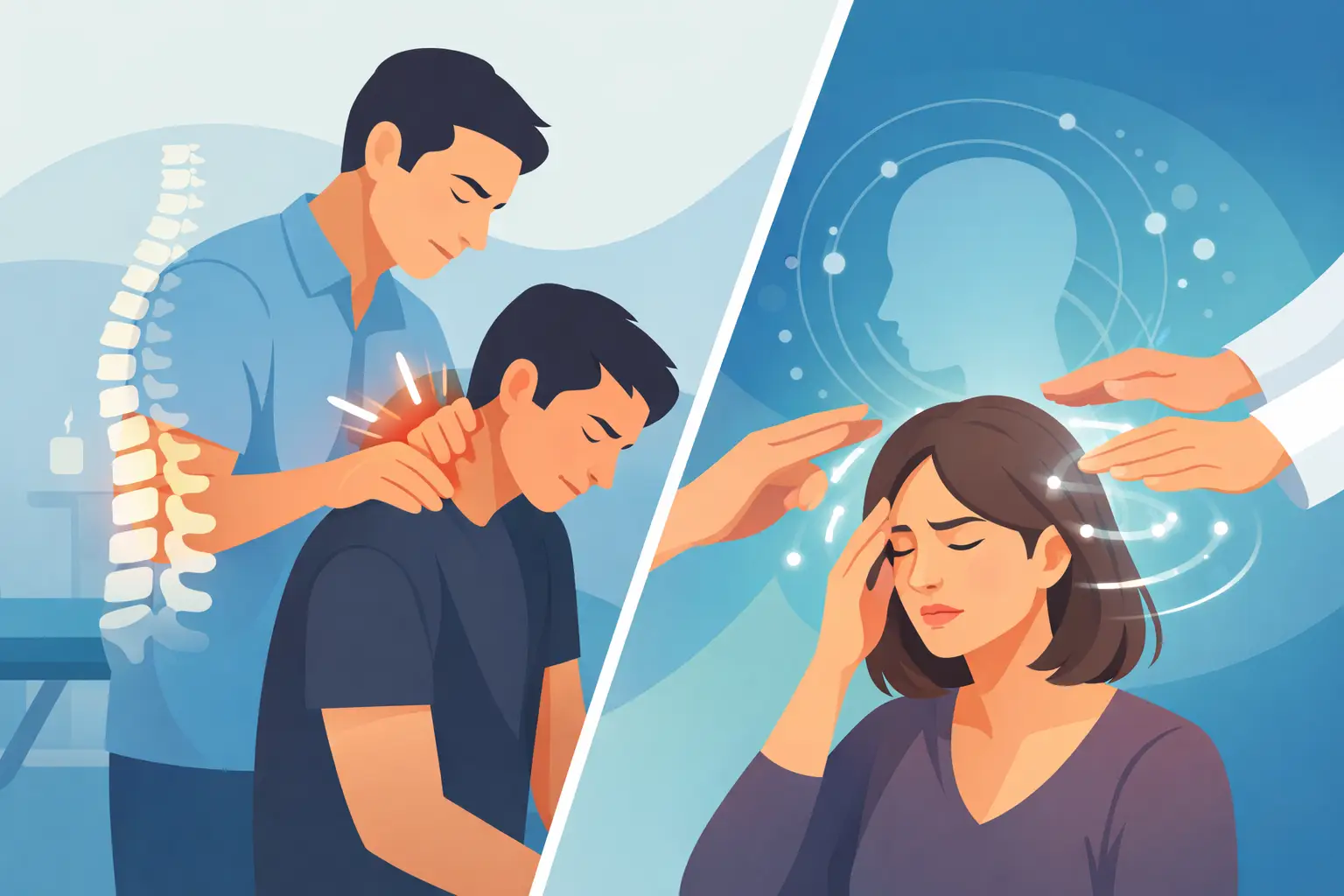
Two ways of pain and tension
If the neck gets hard after a long day at the office, your back pulls when you get up or your shoulders are constantly under tension, the question quickly arises: Chiropractic versus contactless therapy – What fits better? The answer does not depend solely on the pain area. Your comfort, your goals, your previous experiences and the time you can realistically spend on your regeneration are also decisive.
Chiropractic works manually and uses targeted handles. Non-contact applications such as ExoMassage™ take a technological approach: they take place in a clothed manner, do not require manual manipulation and are designed for short relaxation and regeneration times. Both ways appeal to people who want to move more freely again and feel easier in everyday life. However, they are not the same – and it is precisely this difference that counts.
What chiropractic does – and when it doesn’t fit
In chiropractic, a qualified specialist examines mobility, posture and complaints. Subsequently, manual techniques, mobilizations or quick impulses on joints can be used. Many people seek this treatment, especially for acute back and neck problems, limited mobility or the feeling that something is “blocked”.
The big advantage is the direct, individual work on the body. Anyone who finds touch pleasant and wants a detailed manual examination can experience this approach as appropriate. The technical assessment can be valuable, especially in the case of clearly circumscribed movement restrictions.
The flip side: Chiropractic is close to the body, more time-consuming and simply not a feel-good method for some people. Not everyone wants to be touched, change or experience manipulations of the spine and neck. After treatment, sore muscles, fatigue or sensitivity may occur temporarily. Rare but serious risks associated with manipulations in the neck area should be addressed openly before making a decision.
A clean clarification is also important. Sudden paralysis, feelings of numbness, problems with bladder or intestines, fever, inexplicable weight loss, severe pain after an accident or chest pain are not topics for wellness or routine treatment. Medical help is needed here.
How does contactless therapy work?
Non-contact therapy is not a uniform technical term. Behind this can be very different technical or energetic applications. Therefore, it is worth asking specifically: What happens in the meeting? What goals are realistically pursued Who is not allowed to use the application? And what is the evidence for the respective method?
For exomassage, sit or lie fully clothed in a specially developed application unit. Electromagnetic Pulses should address the body without direct contact. The experience is deliberately designed to be low-threshold: no oiling, no undressing, no strong grips and no waiting time for a long manual session. An application typically takes 10 to 20 minutes.
For many working people, this is exactly the practical difference. Between meetings, everyday family life and commuting, an hour-long treatment is not always realistic. A short break, during which the body can calm down, is easier to integrate into the week. If you find closeness from strangers unpleasant or are looking for a discreet opportunity for relaxation, you will find a real alternative in a non-contact concept.
The following applies: Electromagnetic applications do not replace a medical diagnosis and should not be confused with guaranteed healing. The perception of relaxation, relaxation or better well-being is individual. In the case of implants, pacemakers, pregnancy, epilepsy or existing diseases, you should definitely clarify the suitability with the provider in advance and, if necessary, with your doctor.
Chiropractic versus contactless therapy in everyday life
The comparison becomes clearer if you not only look at the name of the method, but at your specific situation. Chiropractic is an active, manual intervention. Contactless therapy relies on comfort, short duration and a relaxation-oriented experience without physical contact.
If you are looking for a precise examination and targeted work on joints, you can be well advised with qualified chiropractic treatment. This applies in particular if movement patterns, stresses or a functional limitation are to be professionally assessed. People who already tolerate and appreciate manual treatment will often see a familiar path in it.
On the other hand, those who, on the other hand, under diffuse stress, muscular tension, who suffers from a severe body feeling or the typical office position, often looks for something else: an uncomplicated break for the body and head. Here the non-contact application shows its strengths. It does not require any preparation, does not exceed personal limits and can feel particularly pleasant when the week is full anyway.
So it’s not about a general “better”. It’s about the right experience for your needs. A person with acutely impaired mobility may first need a medical or manual assessment. After ten hours on the screen, another person does not want any further intensive treatment, but a calm, contact-free regeneration moment. Both decisions can be useful.
The right questions before the appointment
Before booking, check less the big promises than the quality of the advice. A serious passage listens, asks about previous illnesses and explains in a clear way what a session can do – and what not. Skepsis is not an obstacle, but a good decision-making criterion.
For chiropractic offers, ask about training, examination, techniques and possible side effects. In the case of non-contact applications, contraindications, course, duration of the session and how to deal with health problems are particularly relevant. Are your questions clearly answered? Is there no pressure to buy a large package immediately? Then that speaks for a professional approach.
Your body also sets the direction. If you feel more relaxed, flexible and resilient in everyday life after an application, this can be a useful building block of your routine. If complaints remain unchanged, if they get worse or new symptoms appear, a medical clarification is the right next step.
Comfort is not a secondary topic
Many people choose treatments not only according to effect, but whether they will actually use them regularly. A method that sounds appropriate in theory but triggers stress, never fits in in time or feels uncomfortable rarely becomes a helpful habit.
Non-contact, clothed and short: These three factors change the threshold significantly. Especially for people in Zurich and the surrounding area who have a quick relaxation option Between work and private life search, that can be the deciding factor. Not as a replacement for necessary medical care, but as a conscious time for regeneration without medication and without manual treatment.
If you are unsure, do not start with a policy decision for months. Test the process, pay attention to your body feeling and then decide in peace. The best therapy is not the loudest – but the one that feels safe, comprehensible and suitable for your everyday life.