
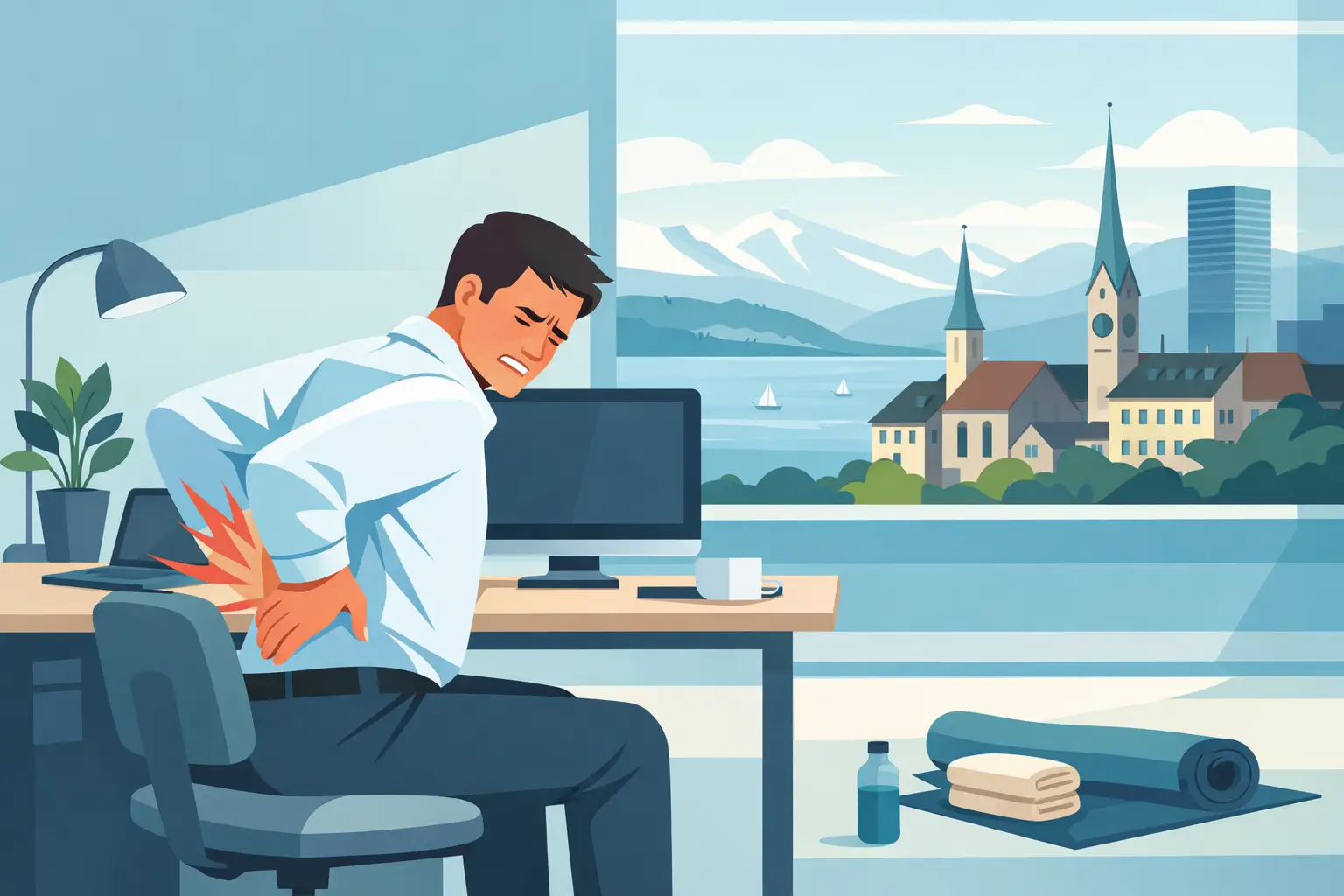
The laptop closes, but the working day is still in the body: a pull between the shoulder blades, a hard neck, a lower back, which becomes noticeable when you get up. Back relaxation after office work in Zurich is therefore not a luxury issue for many working people, but the fastest way back to mobility, rest and a lighter body feeling.
Anyone who sits every day knows the pattern. While meetings, e-mails and deadline pressure continue, the body tenses unnoticed. In the evening, sports, family or relaxation should start – but the back feels like it’s still on duty. The good news: You don’t have to wait until a recurring feeling of tension becomes an integral part of your everyday life.
Why office work puts a strain on the back so often
Sitting isn’t just the problem. It becomes stressful when the body hardly changes its position for hours and at the same time concentration, time pressure or inner tension are added. The head continues to work, the shoulders move up, breathing becomes flatter. Especially the neck, shoulder girdle, thoracic spine and lumbar area often react to this with a feeling of hardness or stiffness.
Even an ergonomic workplace is no guarantee for a relaxed back. A good chair and a properly adjusted screen help, but they do not replace any movement breaks and no conscious balance. If you stay in a generally good position for eight hours, you still remain.
This explains why some people don’t necessarily feel severe pain after a long day at work, but notice a significant exhaustion. The back does not always require a single correction. The whole body often needs an impulse to find out from the working mode.
The first minutes after work decide
The direct transition from the desk to the sofa feels tempting, but often extends the one-sided posture. A short change is better: get up, take a few steps, move your arms loosely and consciously breathe deeply. It’s not about the perfect training program. Just a few minutes signal to the body that the working day is over.
A warm shower, a walk or light mobilization can also do you good. Slowly turn your upper body to the right and left, spin your shoulders and gently straighten the chest side. The dosage is important: movements should be pleasant, not forced against resistance. In the case of acute, stabbing or radiating pain, self-treatment is not the right test place.
Many also underestimate the influence of breathing. If you only breathe high in the chest, you often have the shoulder area on standby. Put a hand on the stomach for two minutes and breathe in and out more. This is not a miracle technique, but it can help not to carry the inner tension any further in the back.
Back relaxation after office work in Zurich: When there is little time left
Between the commute, commitments and the evening program, many do not fit one-hour treatment. This is exactly where a relaxation routine that remains realistic counts. If you only take care of your back when there is a whole free afternoon, you will rarely do so.
A short, targeted application can be attractive for people who do not want to massage manual massage, do not want to undress or find touch unpleasant. ExoMassage relies on a non-contact application electromagnetic pulses. The session takes place fully clothed and is geared to a compact time frame of about 10 to 20 minutes.
This can be a practical way, especially after concentrated screen work, to consciously get out of the performance mode. Instead of starting the evening with the familiar feeling of tension in the back or pressure in the neck, you create a solid regeneration window. How strong and how quickly someone perceives relaxation is individual. Physical stress, sleep, stress levels and the duration of existing complaints play a role.
What an effective routine really needs
The best method is not automatically the most complex, but the ones you use regularly. For some, exercise in the fresh air is enough. Others benefit from yoga, strength training or a classic massage. Still others are looking for one Contactless, time-saving application As a supplement to your everyday life. It doesn’t have to be either or.
It is crucial that you do not pay attention to your back until it comments on every movement. Plan regeneration as binding as an appointment: for example after particularly long video conferences, before a busy weekend or as a fixed break after two to three working days.
At the same time, pay attention to the causes in the office. The screen should be positioned so that you don’t constantly push your head forward. The keyboard and mouse belong close enough to the body so that the shoulders do not constantly pull forward. And instead of getting up exactly every hour, choose a trigger that is suitable for everyday use: after every phone call, before coffee or after sending a larger work package.
Relaxation is more than a loose back
When the back relaxes, more often changes than just the local feeling in the muscle area. Many people perceive freer breathing, fall asleep more easily or feel less mentally driven after the workday. This is understandable: physical tension and stress often reinforce each other.
Nevertheless, one should remain realistic. A relaxation session does not replace medical clarification for complaints that are new, strong or persistent. Numbness, loss of strength, problems with bladder or intestines, fever, pain after an accident or suddenly occurring complaints include medically assessed. It also makes sense for known illnesses or pregnancy to seek professional advice before a new application.
For the typical consequences of a long office day, however, the following applies: Early, regular relief usually makes more sense than week after week to disregard your signals. It’s not about functioning completely without symptoms every day. It’s about giving the back the chance to let go again.
The right time is not just for pain
Many only book relaxation when the neck can hardly be rotated or sitting becomes a problem. It makes more sense to react to the earlier signs: the constant movement on the chair, the shoulder that unconsciously pulls up, the desire to stretch every few minutes, or the tiredness that feels like heaviness in the entire back.
Especially in Zurich, where working days are often tightly timed, time is a decisive factor. A short, uncomplicated solution lowers the hurdle to take care of your own regeneration at all. Non-contact, clothed and without a long interruption – for many, this is exactly the difference between a good intention and a routine that actually remains.
Do not only give your back time after office work. A short, conscious moment for movement, breathing or targeted relaxation can turn the end of the day into the part of the day that really feels like you.